
Among the mysteries and refinements of Indian breathing science, ujjayi pranayama stands out as one of the most versatile, dynamic, and profound tools for regulating the vital energy (prana). Popularly known as the "victorious breath" or "ocean breath," this exercise combines the modulation of airflow with a slight constriction of the glottis, generating an internal purifying heat and establishing a sound anchor for the mind.
Etymology and Conceptualization
The Sanskrit word ujjayi (उज्जायी) is formed by joining the prefix ud (meaning "elevated," "upward," "expansion") with the root jaya (translating as "victory," "conquest," "mastery"). Thus, ujjayi can be interpreted as "that which attains victory" or "the breath that leads to elevation."
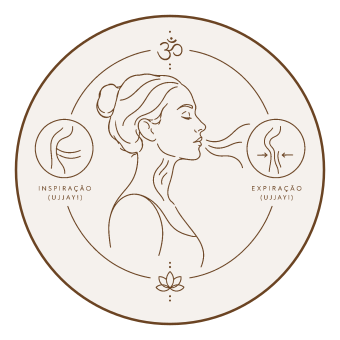
In the taxonomy of classical Yoga, ujjayi is classified both as a kumbhaka (a technique of breath retention and control) and as a sustaining breath applicable while holding and moving through physical postures (asanas). Its main technical characteristic is the production of a gentle, continuous, resonant sound in the laryngeal region — similar to the whisper of the wind through the trees or the distant murmur of the sea — obtained through the partial closing of the glottis.
History and Foundations in the Traditional Scriptures
The practice of ujjayi pranayama has solid roots in the seminal texts of medieval Hatha Yoga and in twentieth-century teaching traditions.
- Haṭha Yoga Pradīpikā (15th century): In Chapter II, verses 48 to 50, the sage Svātmārāma systematizes the method: he explains that, closing the mouth, the yogi should inhale air through both nostrils so that the flow produces a uniform sound perceptible from the region of the throat down to the chest, then hold the breath steadily according to his capacity, and afterward exhale slowly and in a controlled manner through the left nostril. The text notes that this retention eliminates the congestion of phlegm (kapha) in the throat, stimulates the digestive fire (jatharagni), and purifies the bodily tissues.
- Gheraṇḍa Saṁhitā (17th century): In Chapter V, ujjayi is described as a technique capable of warding off physical decay, conferring organic vigor, and leading the practitioner to the mental stability needed for meditative absorption.
- The Postural Revolution of the Twentieth Century: With the codification of Vinyasa Krama and Ashtanga Vinyasa Yoga by T. Krishnamacharya and his disciples (such as K. Pattabhi Jois and B.K.S. Iyengar), ujjayi took on a revolutionary role: it ceased to be practiced solely in the seated meditation posture and became the fluid respiratory engine that connects each bodily movement (vinyasa) to the physical postures.
Physiological, Psychic, and Energetic Benefits and Functions
The impact of ujjayi extends across multiple levels of the human organism, from pulmonary biochemistry to the subtlest states of consciousness.
Physiological and Biochemical Effects
- Regulation of Respiratory Pressure and Gas Exchange: The slight mechanical resistance created by the glottis on the passage of air increases intrathoracic pressure. This keeps the pulmonary alveoli open longer, optimizing hematosis (the exchange of oxygen and carbon dioxide) and strengthening the respiratory musculature.
- Body Heating and Purification (Tapas): The friction of the air in the laryngeal cavity raises the internal body temperature. This endogenous heat stimulates metabolism, improves blood circulation, and aids in the elimination of metabolic waste.
- Parasympathetic Activation and Vagus Nerve Stimulation: The slow, continuous, deep rhythm of the breath stimulates branches of the vagus nerve in the cervical region. As a result, heart rate decreases, blood pressure drops, and there is a lower release of stress-related hormones such as cortisol.
- Upper Airway Health: Helps remove mucus retained in the throat and upper respiratory tract, while also toning the muscles of the larynx and pharynx.
Mental and Emotional Effects
- Auditory Anchor and Focus (Dharana): The whispered sound functions as uninterrupted acoustic biofeedback. When the mind wanders, a change in the tone or rhythm of the sound immediately alerts the practitioner, bringing attention back to the present.
- Quieting of Mental Agitation (Chitta Vritti): The even cadence of the breath eases the hyperactivity of the cerebral cortex, promoting mental clarity, reduced anxiety, and emotional stability.
Energetic and Subtle Effects
- Activation of the Vishuddha Chakra: The vibrational concentration in the throat stimulates the energy center responsible for communication, expression, and purification.
- Alignment of Prana and Apana: Facilitates the convergence of the ascending air (prana) and the descending air (apana) at the navel center, favoring the ascent of vital energy through the central channel (sushumna nadi).
Technical Step-by-Step Execution
To master the technique without generating unnecessary tension, it is recommended to begin with preparatory exercises before establishing continuous flow through the nostrils.
Preparatory Exercise (The "Mirror Whisper")
- Sit comfortably, open the mouth, and exhale through the mouth while making the gentle sound "Haaaah," as if trying to fog up a mirror with warm breath.
- Notice the sensation of a gentle narrowing in the throat (back of the palate/glottis).
- Halfway through the exhalation, gently close the lips, keeping the same internal shape in the throat and releasing the air through the nostrils. The whispering sound should remain.
- Once you understand the adjustment of the glottis, apply the same principle to both the inhalation and the exhalation.
Traditional Seated Execution
- Posture: Sit in a firm, relaxed position (Padmasana, Siddhasana, Sukhasana, or on a chair with an upright spine). Relax the shoulders, neck, face, and jaw (keep the teeth slightly apart inside, with the lips sealed without force).
- Inhalation (Puraka): Inhale slowly, deeply, and continuously through both nostrils, feeling the air gently brush the larynx and produce the low, even, ocean-like sound. Expand the abdomen and chest harmoniously.
- Retention (Kumbhaka — Optional for Intermediate/Advanced Practitioners): Hold the air in the lungs for a few seconds in a stable manner, without creating rigidity in the chest or neck. If appropriate, apply the throat lock (Jalandhara Bandha).
- Exhalation (Recaka): Exhale slowly through the nostrils (or through the left nostril, according to the classical traditional variation), maintaining the constant sound and control of the airflow until fully emptied.
- Rhythm: Begin with cycles of 5 to 10 minutes, prioritizing the stability of the sound over the duration of the breath.
Precautions, Warnings, and Contraindications
Although this is an extremely safe and integrative practice, incorrect execution can cause local or systemic discomfort:
- Avoid Force or Tension in the Throat: The closing of the glottis should be extremely subtle. Never scrape, strain, or force the throat to produce a loud sound. If irritation, throat clearing, or pain occurs, the pressure being applied is excessive.
- Secondary Bodily Tensions: Be careful not to contract the shoulders, clench the teeth, or tense the facial features during the exercise. The posture should remain light and spacious.
- Hypertension and Cardiac Disorders: Practitioners with uncontrolled hypertension, heart problems, or glaucoma should refrain from breath retentions (kumbhakas), performing ujjayi strictly in a continuous flow without pauses.
- Acute Anxiety and Dizziness: If you feel dizzy, short of breath, or a sensation of suffocation, stop the exercise immediately and restore natural, silent breathing.
- Adjustment During Physical Practice (Asanas): When used during the practice of postures, the sound of ujjayi should dictate the pace of the movement. If the breath becomes short, noisy, or broken, it means the physical effort has exceeded a healthy limit.
Integration into Daily Sadhana
Ujjayi pranayama plays the role of a versatile connector in one's personal journey (sadhana):
- As Support in Asanas: Keeps the body warm, prevents injury through awareness of one's limits, and preserves mental focus in dynamic sequences or prolonged holds.
- As a Standalone Pranayama Practice: Performed in a seated position before meditation, it pacifies the nervous system, purifies the energy channels, and establishes the threshold for the withdrawal of the senses (pratyahara).
- As Preparation for Dhyana (Meditation): The constant sound acts as a natural somatic mantra, gently guiding the practitioner from breath control toward inner silence.