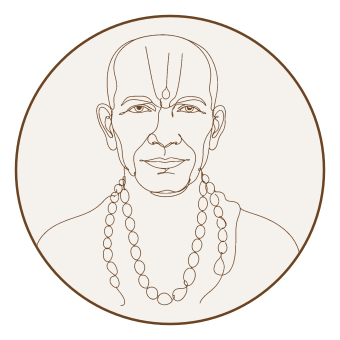
Sri T. Krishnamacharya — The Father of Modern Yoga
Tirumalai Krishnamacharya (1888–1989) is widely recognised as the architect of modern yoga. Born on 18 November 1888 in Muchukundapuram, in the state of Karnataka, southern India, he lived to 100 years of age, leaving a legacy that shaped virtually all forms of physical yoga practised in the world today.
Formation — A Well of Erudition
From childhood, Krishnamacharya was immersed in Vedic culture. A descendant of one of the most famous Vaishnava sages of southern India, Sri Nathamuni, he received from an early age a rigorous education in Hindu scriptures, Sanskrit and philosophy. His journey of learning led him to travel throughout India in search of the finest teachers.
He studied in Varanasi (Benares), the great spiritual centre of Hinduism, where he became an expert in the six classical Indian philosophical traditions (Shad Darshanas): Nyaya, Vaisheshika, Samkhya, Yoga, Mimamsa and Vedanta. He obtained academic degrees in all of them — a feat virtually without precedent.
The great formative journey of his life was a pilgrimage to Tibet, where he studied for seven years (around 1916–1924) under the guidance of the master Sri Ramamohan Brahmachari, near Lake Manasarovar, at the foot of Mount Kailash. It was here that he learned and deepened the practice of Hatha Yoga and pranayama to a level rarely achieved by a single practitioner. His master, on dismissing him, instructed him to return to the world, marry, have a family and teach yoga — the act of transmitting yoga as a service to humanity would be his form of payment (gurudakshina).
The Mysore Palace Yoga School (1934–1955)
The most influential chapter of Krishnamacharya's life began in 1934, when the Maharaja of Mysore, Krishna Raja Wadiyar IV, invited him to establish a yoga school at the Mysore Palace. The Maharaja was a yoga enthusiast who saw in it a way of strengthening the body and spirit of young Indians in a context of independence movements and national awakening.
In this unique setting, Krishnamacharya developed the style of yoga that would become the most influential in the world. With access to the palace library, where he found texts such as the Yoga Korunta (a manuscript on yoga of postures and sequences, attributed to the sage Vamana Rishi), Krishnamacharya created a dynamic system that blended:
- The Hatha Yoga tradition (postures, bandhas, pranayama)
- The codified sequences of the supposed Yoga Korunta
- Elements of Western gymnastics and British physical culture of the time (calisthenics, military exercises)
- His own pedagogical genius and deep anatomical knowledge
The result was a system of postures interlinked and synchronised with the breath, performed in a dynamic rhythm — the embryo of what we know today as Ashtanga Vinyasa Yoga.
The Great Disciples — A Multiplied Legacy
Krishnamacharya's greatness as a teacher lies largely in his ability to adapt the teaching to each student. His most famous disciples testify to this diversity:
B.K.S. Iyengar (Krishnamacharya's brother-in-law)
He began studying with the master around age 16, initially with fragile health. Krishnamacharya adapted the practice to his limitations, and Iyengar developed his own style of extreme rigour in anatomical alignment and use of props. His Light on Yoga (1966) became the worldwide reference manual.
K. Pattabhi Jois
He studied with Krishnamacharya in Mysore from the age of 12. He was responsible for the codification and dissemination of the fixed-series system of Ashtanga Vinyasa Yoga, which he brought to the West from the 1970s onwards.
Indra Devi (Eugenia Peterson)
The first Western woman to be accepted as a disciple of Krishnamacharya (after initial resistance from the master). Devi was the bridge that brought yoga to Hollywood and Latin America.
T.K.V. Desikachar (Krishnamacharya's son)
He inherited and developed his father's more individualised and therapeutic approach, known as Viniyoga — a highly adaptive system where yoga is prescribed as individual therapy.
The Second Phase — Chennai and Spiritual Maturity
With Indian independence in 1947 and political changes that reduced the power of the maharajas, the Mysore palace school gradually closed. Krishnamacharya moved to Chennai (then Madras), where he continued teaching until the end of his life, adopting a more inward, devotional and philosophical approach.
In this phase, his yoga became closer to the original spirit of Patanjali's Yoga Sutras: less emphasis on physical acrobatics and more attention to breath (pranayama), philosophy, meditation and mantra chanting.
The Immortal Legacy
Krishnamacharya passed away on 28 February 1989, a few months short of his 101st birthday. His century of life was itself a living demonstration of yoga's transformative powers. Legend has it that even in old age, he could stop his own heartbeat for brief moments — a demonstration of autonomic control considered impossible by conventional medicine.
His legacy is estimated today to reach hundreds of millions of practitioners worldwide, as virtually all popular modern physical yoga styles — Ashtanga, Vinyasa, Iyengar, Power Yoga, Yin Yoga, and many others — descend directly from his pioneering work in Mysore.
"Teach what is appropriate for the individual." — Krishnamacharya's central principle