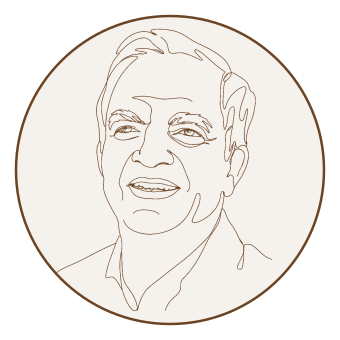
T.K.V. Desikachar — The Master of Individual Adaptation
Tirumalai Krishnamacharya Venkata Desikachar (21 June 1938 – 8 August 2016), known as T.K.V. Desikachar, was one of the most respected yoga masters of the 20th century. Son and direct disciple of the legendary T. Krishnamacharya — widely recognised as the father of modern yoga — Desikachar played a pivotal role in transforming the practice, making it accessible, therapeutic and personalised for practitioners in both the West and the East.
Early Years and Background
Born in Mysore, India, Desikachar grew up immersed in the Vedic tradition, yet initially resisted following in his father's footsteps. Unlike other prominent figures of his generation, he pursued a conventional academic education and graduated as a civil engineer. This analytical and pragmatic mindset would later deeply influence his approach to teaching yoga in a logical, precise and structured manner.
The Turning Point
In the 1960s, a pivotal event transformed the course of his life: upon witnessing a Western woman embrace his father's feet in profound gratitude for being cured of severe insomnia through yoga, Desikachar recognised the extraordinary therapeutic and transformative power of the discipline. He abandoned his engineering career and devoted the next 30 years to intensive, daily study under the exclusive tutelage of Krishnamacharya.
Philosophy and the Concept of Viniyoga
While other celebrated disciples of Krishnamacharya — such as B.K.S. Iyengar and Pattabhi Jois — developed methods characterised by rigid sequences or fixed anatomical alignments, Desikachar dedicated himself to individual adaptation of the practice. This approach became widely known as Viniyoga — the progressive, tailored application of yoga. Its core pillars include:
- Individuality: Practice must respect the practitioner's age, health status, occupation, stage of life and emotional state.
- Centrality of breath: Movement is guided and led by the breath, fostering deep integration between body and mind.
- Therapeutic vision: Integration of asanas (postures), pranayama (breath control), chanting (mantras) and meditation to restore physical, mental and spiritual balance.
The Krishnamacharya Yoga Mandiram (KYM)
In 1976, Desikachar founded the Krishnamacharya Yoga Mandiram (KYM) in Chennai, India, as a non-profit institution to honour and perpetuate his father's teachings. The KYM became one of the world's leading centres for therapeutic yoga and the study of the Yoga Sutras, serving thousands of individuals through tailored instruction and training teachers from around the globe across the decades.
Key Works and Legacy
Desikachar authored classic texts that remain essential reading for yoga students and teachers worldwide:
- The Heart of Yoga: Developing a Personal Practice: regarded as a foundational guidebook of contemporary yoga, it outlines how to build a sustainable personal practice and offers an accessible, clear translation of Patanjali's Yoga Sutras.
- Health, Healing, and Yoga: explores the clinical application and the healing, restorative dimension of the practice.
T.K.V. Desikachar passed away on 8 August 2016, at the age of 78, leaving behind a legacy defined by compassion, respect for individual limitations, and the preservation of yoga as a living path of inner transformation.
"It is not that the person has to adapt to Yoga, but rather that Yoga must be adapted to the person." — T.K.V. Desikachar