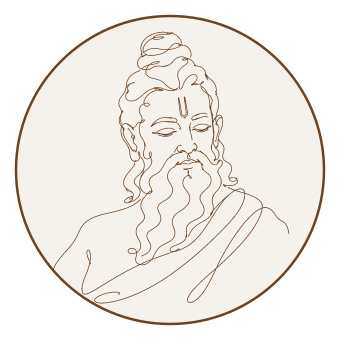
Patanjali — The Codifier of Classical Yoga
Patanjali is one of the most enigmatic, revered, and at the same time mysterious figures in the entire yoga tradition. Little is known with certainty about his life — neither his date of birth nor the exact location of his existence are historically confirmed. What tradition has preserved is his monumental work: the Yoga Sutras, a compendium of 196 aphorisms that systematised, for the first time in a coherent manner, the philosophy and practice of yoga.
The Historical Mystery Behind the Name
The dating of the Yoga Sutras is itself the subject of academic debate. Estimates range from the 5th century BCE to the 4th century CE, with the most widely accepted hypothesis placing Patanjali around the 2nd century BCE. Some scholars argue that the name "Patanjali" does not designate a single author, but a school or tradition of thought that compiled and edited texts over generations.
The most well-known legend about his birth describes him as an incarnation of the serpent god Ananta (or Shesha), the mythical being who holds the universe on his back, transformed into a human being to bring the wisdom of meditation to humanity. According to the mythical narrative, Patanjali "fell" (pat) into the cupped hands (anjali) of Gonika, a devotee praying for a worthy son to whom she could transmit her knowledge — hence the name Patanjali, "the one who fell into praying hands."
The Yoga Sutras: The Foundational Work
The Yoga Sutras of Patanjali are divided into four chapters (padas):
- Samadhi Pada — On contemplation and the states of the mind
- Sadhana Pada — On practice and the eight-limbed path
- Vibhuti Pada — On supernatural powers (siddhis)
- Kaivalya Pada — On final liberation and pure isolation
The most famous definition of yoga appears as early as the second sutra: "Yoga citta vritti nirodhah" — "Yoga is the cessation of the fluctuations of the mind." This phrase of just four Sanskrit words encapsulates an entire vision of the human being: the mind is naturally agitated, and yoga is the process of quieting that agitation to reveal the luminous nature of Purusha (the self or pure consciousness) beneath.
Ashtanga Yoga: The Eight-Limbed Path
Patanjali's most influential contribution to contemporary yoga is undoubtedly his description of Ashtanga Yoga — "eight-limbed yoga" (asta = eight; anga = limb):
- Yama — Ethical restraints: non-violence (ahimsa), truthfulness (satya), non-stealing (asteya), continence (brahmacharya), non-possessiveness (aparigraha)
- Niyama — Personal observances: purity (shaucha), contentment (santosha), ascetic discipline (tapas), spiritual study (svadhyaya), devotion to the Absolute (Ishvara pranidhana)
- Asana — Steady and comfortable posture (for Patanjali, this referred exclusively to the meditation seat)
- Pranayama — Control and expansion of vital energy through the breath
- Pratyahara — Withdrawal of the senses from the external world
- Dharana — Concentration on a single point
- Dhyana — Uninterrupted meditation
- Samadhi — The state of complete absorption, the dissolution of the separation between observer and observed
It is essential to note that in Patanjali's original context, asana did not refer to the hundreds of physical postures we associate with yoga today. Patanjali defines it simply as "sthira sukham asanam" — "a firm and pleasant posture." It was merely the sitting position for meditation. The vast postural repertoire we know today developed centuries later, mainly through Hatha Yoga.
The Dualist Vision: Samkhya and Yoga
Patanjali's philosophical thought rests on the Samkhya tradition, one of the oldest schools of Indian philosophy, which postulates a fundamental dualism between two principles:
- Purusha — Spirit or pure consciousness, unchanging, eternal and plural
- Prakriti — Nature or matter, including the body, emotions and the mind itself (chitta)
Human suffering (dukkha) arises, according to Patanjali, from ignorance (avidya) — the confusion of identifying Purusha (the pure consciousness we are) with the fluctuations of Prakriti (the thoughts, emotions and sensory perceptions we experience). Yoga is therefore a process of progressive discrimination (viveka) that culminates in Kaivalya — the isolation or liberation of pure consciousness, which recognises itself as independent and distinct from all matter.
The Enduring Legacy of the Yoga Sutras
For centuries, the Yoga Sutras were the subject of numerous commentaries by great Indian philosophers, from Vyasa (4th–5th century CE) to Vachaspati Mishra (9th century). In the West, the work was translated and interpreted by figures such as Swami Vivekananda, who presented it to the English-speaking world at the end of the 19th century.
Today, the Yoga Sutras remain the fundamental reference text for those wishing to understand yoga beyond its physical dimension. Its reflections on the nature of the mind, the construction of identity and the mechanisms of human suffering prove surprisingly relevant, finding parallels in modern psychology and neuroscience.
"Yoga citta vritti nirodhah." — Patanjali, Yoga Sutras, I.2
"Yoga is the cessation of the fluctuations of the mind."