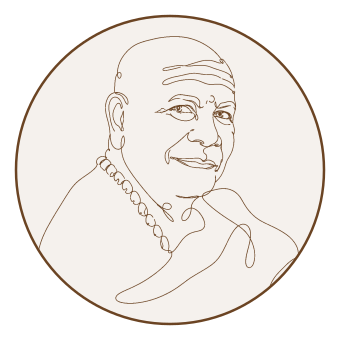
K. Pattabhi Jois — The Guardian of Ashtanga Vinyasa Yoga
Krishna Pattabhi Jois (26 July 1915 – 18 May 2009), affectionately called Guruji by his countless disciples around the world, was the master responsible for codifying, preserving and bringing to the world the Ashtanga Vinyasa Yoga — the dynamic style of yoga that transformed modern physical yoga practice and gave rise to Vinyasa, Power Yoga and many other contemporary styles.
Early Years and the Meeting with Krishnamacharya
Pattabhi Jois was born on 26 July 1915 in Kowshika, a small village in Hassan district, Karnataka state, southern India. Son of a Brahmin astrologer and priest, he grew up in a devout family and was initiated from childhood into Hindu religious practices, Sanskrit and Vedic scriptures.
The encounter that would change his life occurred in 1927, when he was 12: he witnessed a yoga demonstration by Sri T. Krishnamacharya at the local school hall in Hassan. So impressed was he that the next day he went to meet the master in person and asked to be accepted as a student. Krishnamacharya accepted him, and Jois studied with him every day before dawn for two years.
When Krishnamacharya moved to the Mysore Palace in 1930, Jois followed. He moved to Mysore at just 14 and continued studying with the master for 25 consecutive years. In parallel, he enrolled at the Mysore Sanskrit College, eventually earning the title of Vidwan (scholar).
Ashtanga Vinyasa Yoga — The Series System
The Ashtanga Vinyasa Yoga is a dynamic system that synchronises the breath (ujjayi pranayama) with progressive postures organised into fixed series.
The Tristhana — Three Points of Attention
- Asana — The correct posture
- Vinyasa — The linking of breath with movement
- Drishti — The gaze point in each posture
To these are added the bandhas (energy locks): mula bandha (perineal contraction) and uddiyana bandha (abdominal contraction).
The Ashtanga Vinyasa Series
The system is organised into six series of increasing difficulty:
- Yoga Chikitsa (Primary Series) — Yoga therapy; body purification
- Nadi Shodhana (Intermediate Series) — Nervous system purification
3–6. Advanced Series A, B, C and D — Reserved for very few exceptional practitioners
The Mysore Method — Individualised Learning
The Mysore style — where each student practises at their own pace while the teacher circulates and gives individual adjustments — is one of Pattabhi Jois's most distinctive pedagogical contributions. Students advance posture by posture only when the teacher deems they have safely mastered the previous one.
Arrival in the West
Jois founded the Ashtanga Yoga Research Institute in Mysore in 1948 and began teaching at Mysore University in 1937. The global breakthrough came in the 1970s when Western students began arriving in Mysore seeking a more authentic practice. Jois made his first Western teaching trip in 1975, going to the USA. By the 1980s and 90s, Ashtanga Vinyasa had spread across Europe, North America and Australasia.
The Legacy
Pattabhi Jois passed away on 18 May 2009 in Mysore, aged 93. His grandson R. Sharath Jois now leads the Ashtanga Yoga Research Institute as the official custodian of the lineage.
The Ashtanga Vinyasa Yoga he taught directly influenced Vinyasa Yoga, Power Yoga and countless other dynamic styles, reaching tens of millions of practitioners worldwide.
"Practice, and all is coming." — K. Pattabhi Jois