If asana captured the spotlight of the Western world through the beauty and dynamism of physical postures, pranayama is the secret kept backstage, the invisible force that transforms gymnastics into transcendence. While the body moves or stabilizes on the practice mat, it is the breath that dictates the rhythm of the mind. In traditional yoga, the mastery of the breath is not a simple pulmonary exercise; it is the master key for accessing vital energy (prana) and the definitive link between the external world and the deepest states of meditation.
Pranayama on Patanjali's Ladder: The Gateway to the Mind
In the structure of Patanjali's ashtanga yoga, described in the Yoga Sutras, pranayama occupies the fourth step, strategically positioned just after asana. Patanjali establishes a clear criterion: the regulation of the breath occurs after the physical posture has become stable and comfortable (tasmin sati).
For classical yoga, pranayama is defined as the interruption of the automatic flow of inhalation and exhalation. By bringing awareness to this act that usually occurs unconsciously, we bring about a drastic change in the mind. Patanjali does not describe complex techniques or exhaustive retentions, but points directly to the metaphysical effect of the practice:
- The dissolution of the veil: Pranayama attenuates the veil that conceals the light of inner knowledge (tatah kshiyate prakashavaranam). It purifies the mental impurities that generate dispersal.
- Preparation for stillness: By pacifying the respiratory rhythm, the mind finally becomes capable and qualified for concentration (dharana), the next step toward deep meditation.
The Alchemy of Hatha Yoga: Taming the Breath to Stabilize the Mind
Centuries later, the hatha yoga tradition deepened and detailed the subtle physiology of this process. The classic treatise Hatha Yoga Pradipika immortalized the intimate connection between breathing and mental activity with the aphorism: "Chale vate chalam chittam" — when the breath oscillates, the mind oscillates; when the breath settles, the mind also finds rest.
While Patanjali focuses on mental stillness, hatha yoga approaches the energetic body. Through pranayama techniques (such as alternate nostril breathing, nadi shodhana, or the ocean breath, ujjayi), the practitioner seeks to:
- Purify the energy channels (nadis): Allow prana to circulate without obstacles through the subtle structure.
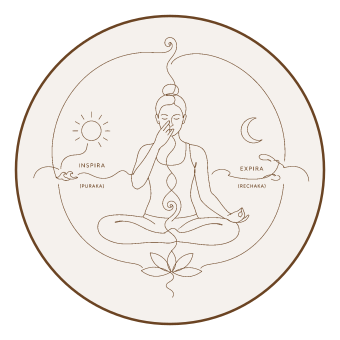
- Balance the polarities: Balance the solar (pingala) and lunar (ida) energies, which cross our central axis.
- Awaken latent force: Channel energy upwards, toward the expansion of consciousness.
The Contemporary Perspective: From Stress Science to the Anatomy of the Breath
In the contemporary West, we are living in an era of fascination with what is called breathwork. Modern medical science and neurophysiology have rediscovered what ancient sages mastered empirically: breathing is the only component of the autonomic nervous system that we can voluntarily control.
For the modern Westerner, immersed in digital noise, chronic haste, and high levels of anxiety, pranayama emerges as an urgent biological antidote:
- Parasympathetic activation: Practices that emphasize prolonged exhalations stimulate the vagus nerve, instantly reducing heart rate, blood pressure, and cortisol levels (the stress hormone).
- Focus and mental clarity: By regulating oxygen and carbon dioxide levels in the blood, pranayama improves cerebral oxygenation, combating mental fatigue and the cognitive fog of everyday life.
This scientific validation is fantastic and legitimate, as it builds a bridge of trust for the skeptical mind of the Western person. However, the yoga perspective invites us to go beyond the purely therapeutic benefit.
The Breath as Sadhana: Beyond Biohacking
The great turning point for the contemporary practitioner is not to reduce pranayama to a mere "productivity hack" or biohacking tool. For it to be consistent with its roots, breath control must be integrated into sadhana — the daily practice performed with a spiritual purpose.
On the mat of a conscious sadhana, the act of breathing takes on a new dimension:
- Cultivation of sankalpa: Each breathing cycle is imbued with a clear intention of presence and purification, rather than being a mere mechanical count of seconds.
- Training in equanimity: Observing the moments of breath retention (at empty or full lungs) teaches us to inhabit the spaces of silence and discomfort in life without reacting with despair.
- A bridge to the invisible: The Breath becomes a constant reminder that we are connected to something greater; inhaling is receiving life; exhaling is surrendering to the flow of the universe.
Tuning one's life
Pranayama is, fundamentally, the art of tuning our inner instrument. We don't need to isolate ourselves in Himalayan caves to feel its power. In great metropolises, amid modern challenges, closing our eyes for a few minutes and guiding the breath with awareness is an act of peaceful rebellion against haste. It is the moment when we stop being driven by the external impulses of the world and begin to dictate, from the inside out, our own peace.