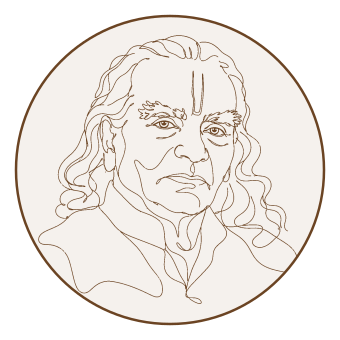
B.K.S. Iyengar — The Architect of Alignment
Bellur Krishnamachar Sundararaja Iyengar (14 December 1918 – 20 August 2014), known worldwide as B.K.S. Iyengar, was one of the most influential and celebrated yoga teachers of the 20th century. Creator of the style bearing his name — Iyengar Yoga — he revolutionised the way the Western world understands and practises yoga, making it accessible, safe and therapeutic for people of all ages and physical conditions.
A Childhood Marked by Illness
Iyengar was born in the small village of Bellur, in Karnataka state, southern India, the eleventh child of a large, poor Brahmin family. His childhood was bleak: he was born during a Spanish flu epidemic and inherited from it extremely fragile health. He suffered from malaria, typhoid fever, tuberculosis and other health problems that kept him thin and debilitated throughout childhood and adolescence.
Yoga entered his life almost by accident. In 1934, at 15, he was sent by his mother to Mysore to stay with his brother-in-law, Sri T. Krishnamacharya, who had a yoga school in the maharaja's palace. Krishnamacharya, initially reluctant given the young man's fragility, eventually accepted him as a student and used yoga to rebuild his health.
From Illness to Mastery — Transformation Through Yoga
Regular practice completely transformed Iyengar's body and health. Where there had previously been fragility, extraordinary strength, flexibility and endurance developed. This personal journey profoundly shaped his approach to yoga: he knew from personal experience that yoga could radically transform the human body, even starting from very unfavourable conditions.
In 1937, Krishnamacharya sent him to Pune to teach yoga, a city with no yoga tradition. Iyengar was just 18 with few certainties. He taught for years in modest conditions, studying and practising tirelessly to perfect his technique and deepen his anatomical knowledge.
The Innovation of Props
One of Iyengar's most revolutionary contributions to yoga was the systematic development of the use of props: wooden and foam blocks, belts, folded blankets, chairs, bolsters, ropes attached to walls — simple objects that allow anyone, regardless of flexibility or physical condition, to access the correct posture.
This innovation was born of pedagogical necessity: how to teach students with injuries, the elderly, pregnant women or people with physical limitations? Rather than adapting the posture to the student's limitation (which could compromise the benefit), Iyengar developed tools that bring the correct posture to the student, without violating their body.
Light on Yoga — The Bible of Postures
In 1966, Iyengar published Light on Yoga, a work that would become the most influential yoga book of the 20th century. With detailed photographs of Iyengar himself in 200 postures, step-by-step instructions and progressive sequences, the book became the global reference for teachers and practitioners. It has been translated into more than 17 languages and sold millions of copies.
World Recognition
Iyengar's fame grew exponentially from the 1950s, when he began teaching in Europe, notably the UK, thanks to violinist Yehudi Menuhin, who became his student in 1952. Menuhin, impressed by the transformation yoga effected in his own musical performance, became his principal ambassador in the West and wrote the preface to Light on Yoga, describing Iyengar as "my guru and friend."
The Ramamani Iyengar Memorial Yoga Institute (RIMYI) in Pune, founded in 1975, became a pilgrimage centre for practitioners worldwide. In 2014, the Indian government honoured him with the Padma Bhushan, one of India's highest civilian honours.
Iyengar Yoga — Fundamental Principles
- Precision and alignment: Each posture is performed with meticulous attention to anatomical alignment.
- Use of props: Tools that allow safe and correct access to the posture for all practitioners.
- Holding postures: Unlike more fluid styles, Iyengar Yoga encourages extended holding of each posture.
- Therapeutic sequencing: Postures organised in specific sequences to address different health conditions.
- Pranayama integration: Breathing is taught separately and in great depth.
The Legacy
Iyengar passed away on 20 August 2014 in Pune, aged 95, active as a teacher and practitioner until very close to the end. Iyengar Yoga has standardised certifications in more than 70 countries, with thousands of certified teachers and dozens of affiliated institutes worldwide.
"Yoga is not an ancient myth buried in oblivion. It is the most valuable inheritance of the present." — B.K.S. Iyengar